

In my last post, I suggested that the best journaling prompt isn't necessarily the one someone else gives you.
I still believe that.
The longer we keep a journal, the more our own lives begin supplying the questions worth exploring.
And yet, over the years, I've noticed something interesting.
Whenever someone begins therapy with me and asks, "Where should I start?" I almost always recommend the very same prompt.
Not because it's the most profound, nor the most "therapeutic," but because it's simple enough that almost anyone can do it.
After years of recommending it to clients—and practicing it myself—I have come to believe that its simplicity is precisely what makes it so powerful.
A Two-Part Question
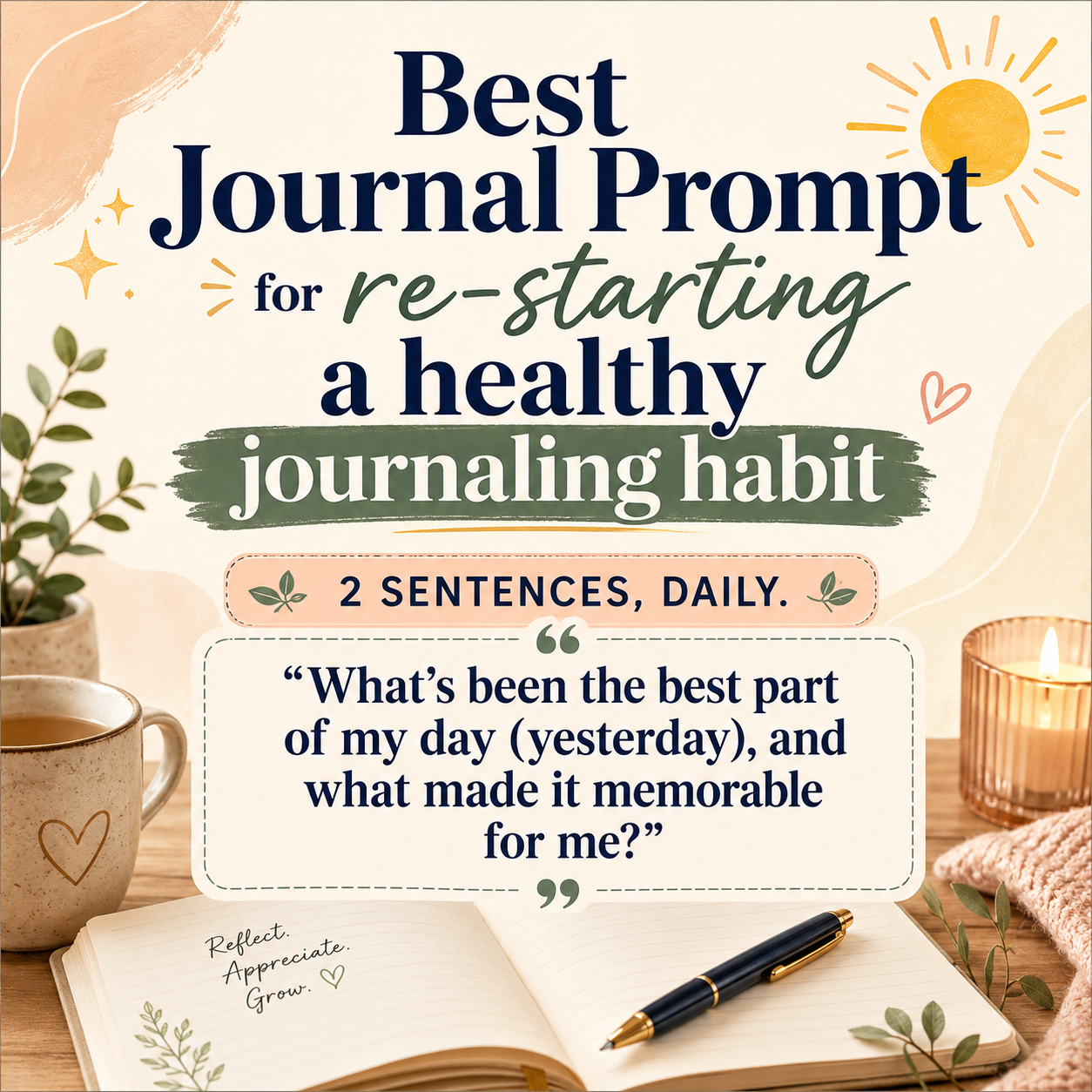
If you're looking for an easy way to begin the habit journaling, here's the two-question prompt that I recommend:
What was my favorite moment from the last twenty-four hours?
Then,
What made that moment memorable or special?
That's it. One or two sentences is enough.
I often encourage people to answer these questions every day for two or three weeks, especially if they're trying to establish a journaling habit.
It takes only a few minutes. Yet this prompt has a remarkable way of changing how we move through our days.
"Nothing Really Happened Today."
When I first ask this question in therapy, some people answer almost immediately. Others look at me with a puzzled expression. Clients often say, "Honestly... nothing really happened."
I've learned to smile or nod with understanding, but to gently not accept that answer too quickly. Instead, I encourage becoming more curious together. I'll ask follow-up questions like:
- "What did you have for lunch yesterday?"
- "Who did you spend time with yesterday?"
- "What's something that made you smile?"
- "Did anything surprise you?"
- "Was there a moment—even a small one—that felt just a little lighter than the rest of the day?"
Rarely does the answer involve some dramatic life event. We don't win the lottery every afternoon. Almost always, it's something beautifully ordinary.
- "I had an amazing fish taco for lunch."
- "My dog greeted me at the door."
- "I talked with my sister for twenty minutes."
- "The sunset was incredible on my drive home."
The magic isn't in how extraordinary the moment is. It's in learning to notice that it happened at all.
The Second Question Is Where the Real Work Begins
If the first question helps us remember a meaningful moment, the second helps us understand why it mattered.
What made it memorable or special?
This is where journaling begins moving beyond recording events.
Perhaps the taco reminded you how much you enjoy trying new foods. Perhaps the conversation with your sister helped you realize how deeply you value feeling understood. Perhaps the sunset reminded you how rarely you pause long enough to notice beauty.
Little by little, these reflections begin revealing something larger. Our values. Our longings. The experiences that leave us feeling alive.
What initially looks like a journal about tiny, pleasant moments slowly becomes a journal about what matters most.
Something Begins to Change
One of the most delightful things I've noticed—both in my own life and in the lives of many clients—is that this practice eventually follows us out of the journal.
After a few days, something unexpected happens.
I'll be walking through my day and suddenly catch myself thinking, "This is kind of a lovely moment." Or, "I wonder if this will be the one I write about tonight."
Nothing about the moment has changed. What has changed is my attention. Instead of rushing past ordinary moments on my way to something bigger, I begin noticing that life is already offering small gifts all around me.
The more consistently we practice paying attention to these moments, the easier they become to recognize. It's not that life suddenly becomes perfect. It's that our awareness becomes more balanced. We begin noticing moments of connection, beauty, gratitude, humor, curiosity, and contentment alongside life's inevitable challenges.
A Year's Worth of Favorite Moments
On any given day, this practice may not seem especially significant. Writing two or three sentences hardly feels life-changing. But imagine doing it for a year.
Imagine celebrating New Year's Eve and opening a journal filled with 365 favorite moments.
Not 365 extraordinary achievements.
Not 365 perfectly happy days.
Just 365 reminders that your life contained beauty worth noticing: A collection of the year's most meaningful conversations, delicious meals, and moments of self-care.
A child's laughter.
A quiet cup of coffee before the house woke up.
A breakthrough in therapy.
A handwritten note from a friend.
Collected together, these moments become something more than memories.
They become evidence that even in seasons marked by stress, grief, uncertainty, or depression, life continued offering moments of goodness.
Sometimes we simply needed help noticing them.
A Gentle Place to Begin
There are countless ways to keep a journal.
Some people process difficult emotions.
Others explore dreams, record prayers, solve problems, or write pages of free-flowing thoughts.
All of these approaches have their place.
But if you've been waiting for the perfect time to begin, or you've always felt intimidated by the blank page, perhaps this simple question is enough.
What was my favorite moment from the last twenty-four hours?And, why was it memorable or special?
You may discover that you're doing much more than collecting happy memories.
You may be quietly learning to recognize what helps you feel most fully alive.