

If you have ever bought a beautiful journal, opened to the first pristine page, written the date at the top…and then suddenly felt as though you were being asked to compose the Gettysburg Address, you already know something important about journaling:
The tool matters.
For some people, a pen loosens the mind. For others, handwriting turns self-reflection into an occupational-therapy exercise involving cramped fingers, bad spelling, and a mysterious deterioration in penmanship around paragraph three.
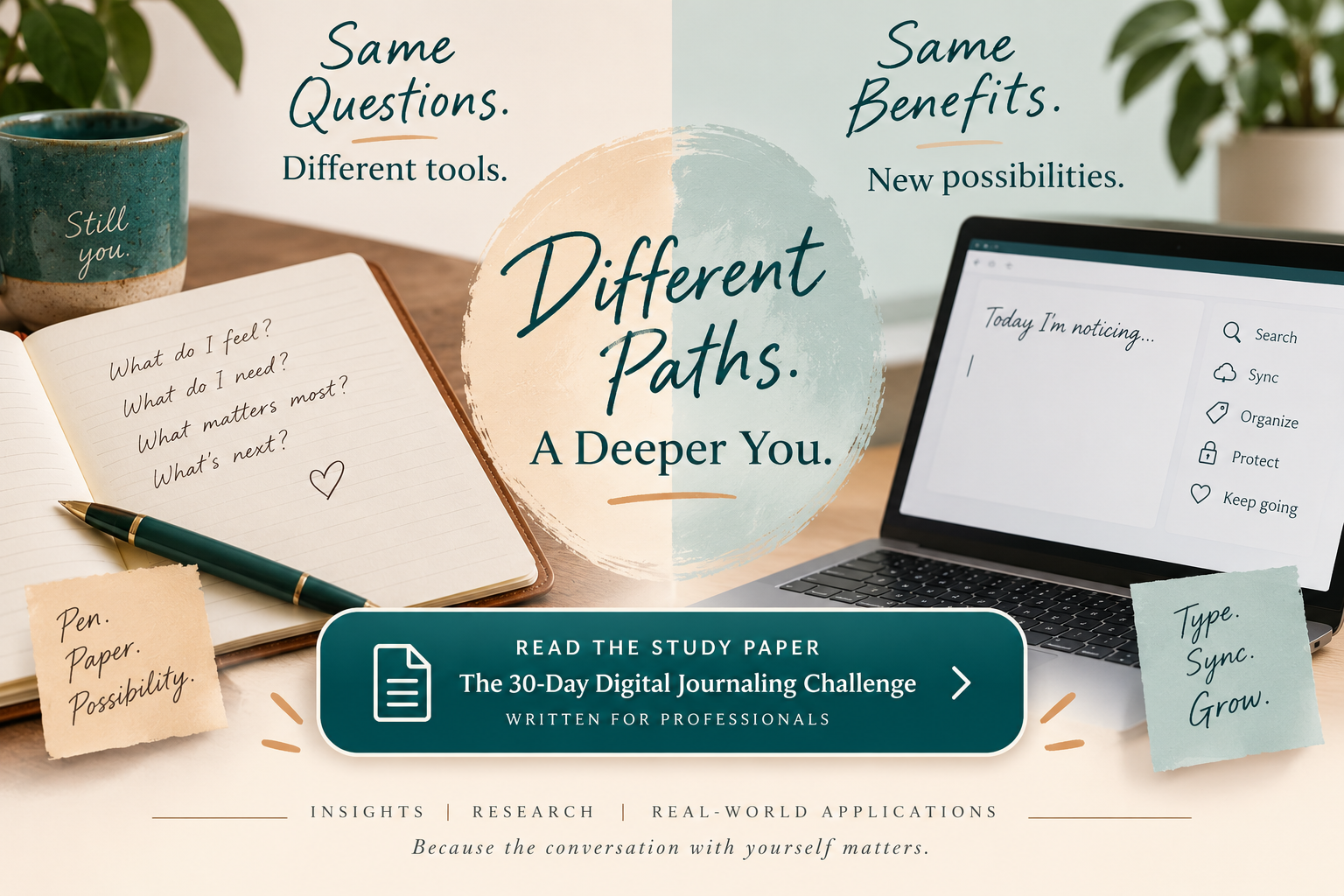
Back in 2014, before journaling apps had multiplied like rabbits and before we routinely asked artificial intelligence to summarize our grocery lists, I helped create an experiment called The 30-Day Digital Journaling Challenge. The resulting report, published in 2015 with Kathleen Adams, LPC, and Brenda Hudson, Ph.D., asked a fairly simple question:
Does meaningful journaling really require paper?
Spoiler: apparently not.
But the interesting answer is more nuanced than that.
First, What Was the 30-Day Digital Journaling Challenge?
The Challenge grew out of my own transition from lifelong handwritten journaler to reluctant keyboard convert.
I had journaled since adolescence and accumulated what the paper rather charmingly describes as “storage tubs filled with my handwritten journals.” When I began experimenting seriously with digital journaling, I discovered that the essential ingredient of journaling—honest, curious inquiry into oneself—didn't disappear when my pen did. In fact, I found digital writing faster, easier to preserve, searchable, portable, and surprisingly enjoyable.
So I created a free, month-long online experience. Participants received daily emails containing prompts, writing techniques, resources, and information about journaling software. A private Facebook group added community and discussion, and volunteer contributors from the expressive-writing world supplied prompts and resources.
More than 1,500 people signed up during October 2014. Of those, 471 opted into the research questionnaire, and 177 completed the post-Challenge survey.
That gave us an unusually interesting snapshot of what happened when people accustomed—or sometimes not at all accustomed—to journals spent a month typing instead of scribbling.
So…Does Typing "Count" as Journaling?
This is the question paper-journal loyalists sometimes ask with the faint concern of someone discovering their neighbor puts ketchup on steak.
The short answer from this project was: yes.
Before the Challenge, only 59% of men and 48% of women thought typing produced outcomes comparable to handwriting. Yet after 30 days, about two-thirds of respondents said their typed entries had expressed their innermost thoughts and feelings.
That matters.
The therapeutic value of journaling probably does not live inside a Bic pen.
What seems to matter more is whether the medium allows you to make contact with thoughts, feelings, memories, questions, contradictions, and experiences that might otherwise remain vague or unexamined.
And participants reported plenty of that.
Among the strongest reported benefits were:
- Clarity and insight on difficult issues — 66.3%
- Reduced stress — 58.3%
- Knowing oneself better — 56%
- Aligning priorities with larger goals or purposes — 52.3%
- Uncovering passions, goals, or creativity — 51.4%
The table on page 15 also reports benefits related to consistency, spiritual reflection, productivity, and coping with physical-health concerns.
In other words, nobody reported that Microsoft Word caused their psyche to evaporate.
Digital Journaling Has Some Very Practical Advantages
Digital journaling solves several mundane problems that handwritten-journal enthusiasts occasionally pretend don't exist.
- You can type quickly.
- You can search old entries.
- You can organize writing by topic.
- You can carry years of journals without requiring a hand truck.
- You can synchronize entries across devices.
And depending upon the platform, you can add photographs, dates, reminders, tags, or other forms of information that make a journal more like a personal archive.
Participants especially appreciated accessibility, syncing across platforms, reminders, simple interfaces, customization, and searchability. The report discusses then-popular tools such as Day One, Diaro, Penzu, and Writr—several of which now qualify as archaeological specimens in Internet years.
Digital journaling may also lower the barrier for people who simply dislike handwriting. In our sample, 74% of men were comfortable or very comfortable typing, but only 56% felt similarly comfortable writing by hand. The report suggested that digital journaling might therefore invite some people into reflective writing who otherwise would never start.
That finding still strikes me as clinically useful.
If someone tells me, “I hate journaling,” one of my first questions is:
Do you hate journaling—or do you hate handwriting?
Those are not the same thing.
But Handwriting Still Has a Body
Here is where I would add something today that interests me even more as a somatic psychotherapist.
Typing and handwriting are not identical experiences.
One participant captured the distinction beautifully, reporting that digital writing was faster and excellent for quickly “exhaling” an experience—but that when strong emotion arrived, nothing quite replaced forceful pen strokes on paper.
That makes intuitive sense.
Handwriting has pressure. Rhythm. Speed. Pauses. Cross-outs. Size. Direction. The physical feel of the page. Sometimes what the body does while writing becomes part of the information.
Digital journaling removes some of those channels while adding others.
So rather than asking whether analogue or digital journaling is better, I now prefer a different question:
What does this nervous system need from writing today?
Sometimes the answer is a fountain pen and ten uninterrupted minutes.
Sometimes it is two frantic paragraphs typed into a phone in a parking lot.
Both can be psychologically meaningful.
The Slightly Academic Part Where I Establish That I Didn't Just Make This Up Over Brunch
The Challenge did not arise in an intellectual vacuum.
Our paper situated the project within several decades of expressive-writing scholarship, including the work of psychologist James Pennebaker and the research tradition stemming from his studies of structured emotional writing. The Pennebaker paradigm generally asks participants to write repeatedly about significant or stressful experiences while integrating both facts and feelings, eventually exploring meaning, identity, and learning. Hundreds of studies have used variations of this approach.
The paper also drew upon Kathleen Adams' extensive work in journal therapy, including her Journal Ladder, a model that ranges from highly structured, concrete writing methods to increasingly intuitive and open-ended forms of reflection.
And yes, I had a somewhat unusual seat at this particular table.
I originated the 30-Day Digital Journaling Challenge, designed and coordinated the program, operated digital-journaling resources including Write4Life.com and EasyJournaling.com, edited the Challenge material, interviewed experts through podcasting, and then co-authored the resulting report with Adams and qualitative researcher Brenda Hudson, Ph.D. The paper itself identifies me as the originator of the Challenge and describes my background as a journal-writing teacher/facilitator, podcaster, author, and longtime journaler.
I mention all of that not because “I once made a website” belongs after one's name like a graduate degree.
It doesn't.
I mention it because my current work as a therapist using journaling and expressive writing is part of a much longer professional curiosity: What happens when human beings deliberately put inner experience into words?
I was asking that question before I became a psychotherapist.
I'm still asking it.
Now for the Part Where We Admit This Was Not the Framingham Heart Study
The paper very appropriately calls the project an “exploratory, non-academic pilot study.”
That qualifier deserves respect.
There was no control group of comparable participants assigned to handwritten journaling. Participants self-selected into a free event about digital journaling, which means we were essentially studying people who had already raised their hands and said, “Sure, I'll try the digital-journaling thing.”
That introduces obvious selection bias.
There was also substantial attrition: 471 people completed the pre-questionnaire, but only 177 completed the follow-up.
And then there was what researchers politely call a data-collection error, which is academia's way of saying, “Well, that didn't go as planned.”
Participants were supposed to create a four-digit identifier so their before-and-after questionnaires could be matched. Unfortunately, many people forgot it, omitted it, or chose wonderfully original identifiers such as “1111” and “1234.” Consequently, complete gender matching was available for only 86 post-Challenge respondents.
There are also broader historical limitations worth acknowledging.
I was very enthusiastic about emerging digital technology, and I was the person who created the Challenge. That's hardly methodological neutrality. I wanted to know whether digital journaling worked because I had already become excited about its possibilities.
The project also emerged during a comparatively freewheeling period of Internet culture. Recruitment spread through email lists, blogs, Facebook, Twitter, app communities, podcasts, sponsors, reposts, and word of mouth. The paper explicitly acknowledges that the resulting audience size and demographic composition could not be reliably estimated.
A cleaner way to say this today might be:
The study was conducted during an earlier phase of online community research, when large-scale Internet recruitment was less standardized and contemporary expectations regarding sampling precision, platform governance, privacy, data stewardship, and research-specific digital consent were still evolving.
Or, less academically:
It was the Internet in 2014. We had enthusiasm, Facebook groups, email blasts, and optimism. The guardrails were still under construction.
That doesn't invalidate the observations. But it does tell us how cautiously to interpret them.
One Finding I Still Find Fascinating: Men Showed Up
Historically, self-selected journal-writing groups had reportedly been overwhelmingly female—roughly 85% women and 15% men.
But in the Digital Journaling Challenge, 34.4% of participants were men.
Even more interesting, many of those men were relatively new to journaling.
Over half reported beginning their journaling practice either within the previous two years or during the Challenge itself.
By the end, men and women reported strikingly similar benefits from the practice. The authors concluded that the major distinction appeared to be less about gender than about experience with reflective writing. Newer journalers often needed more concrete structure, whereas seasoned journalers were comfortable with abstract, psychologically oriented prompts.
That remains an important teaching point.
People sometimes say:
“I'm bad at journaling.”
Usually they aren't.
They simply haven't yet discovered the form of journaling that fits them.
Apparently, People Also Have Strong Opinions About Prompts
One of my favorite parts of the report concerns the writing prompts.
Some participants loved them.
Some did not merely dislike them. They appeared to regard them as a personal affront.
One participant summarized the experience as too much “happy happy joy joy.”
This is excellent evidence for another journaling principle:
A prompt is an invitation, not a subpoena.
If “Write about your deepest childhood longing” makes you want to close the laptop and reorganize the refrigerator, perhaps today's journal entry should begin:
Why I absolutely refuse to write about my deepest childhood longing.
Congratulations.
You're journaling.
So Which Should You Use: Digital or Analog?
My answer after all these years is:
Yes.
Use whichever medium helps you return. Use paper when slowness helps. Use digital when speed helps. Write by hand when you want texture, embodied expression, or freedom from screens. Type when you want accessibility, portability, organization, longevity, or search.
Switch between them.
Dictate an entry. Write three sentences in your phone.
Buy the absurdly expensive notebook.
Use the free notes app already installed on your device.
The original paper (you can read it here) concluded that digital journaling appeared to offer meaningful emotional and cognitive expression without an obvious sacrifice in depth, and that most participants intended to continue using it.
I would phrase the conclusion a little differently today:
The therapeutic power probably isn't hiding in the paper or the pixels.
It is in the relationship you develop with your own experience.
The journal—whether bound in leather or protected by Face ID—is simply where you agree to meet yourself.
And please, remember your password!